
Hier geht es zum deutschen Rezept
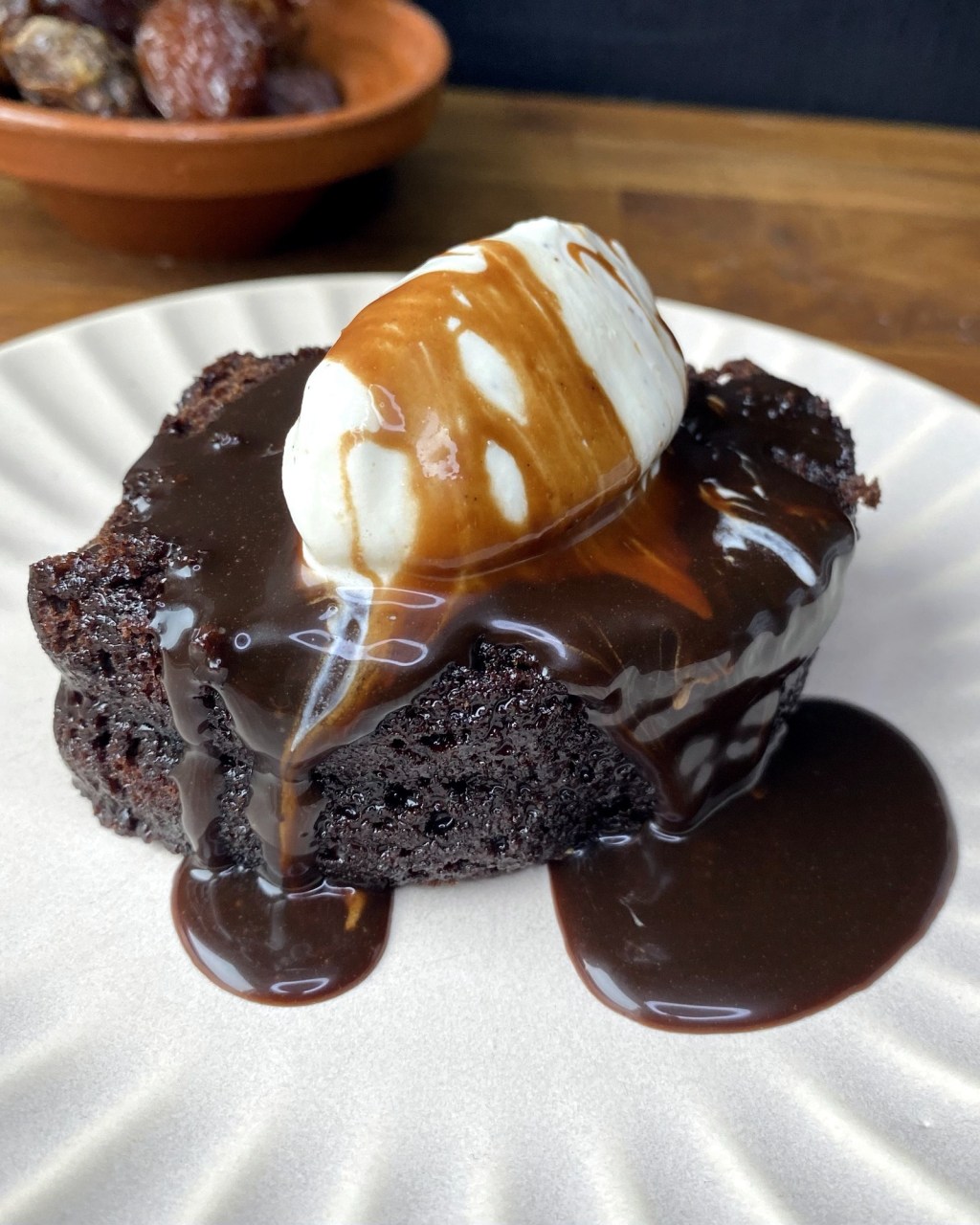
This brownie tastes like sticky toffee pudding. Dates cooked with coffee and cocoa go into the batter. While the cake is still hot, it soaks up a toffee sauce.
I serve it with vanilla ice cream and more sauce. For me, it is simply the best sticky toffee pudding. The recipe makes about 8 pieces. I baked it in a loaf tin measuring 30 x 10 x 6 cm.
Ingredients
Date Puree
- 160 g Medjool dates, pitted (any dates work)
- 200 g hot water
- 2 tbsp cocoa powder
- 2 tsp instant coffee
- 1 tsp baking soda
Brown Butter
- 90 g butter
- 10 g skimmed milk powder
Brownie Batter
- The brown butter from above
- 60 g muscovado sugar
- 60 g light brown sugar
- 2 eggs, room temperature
- 2 tbsp molasses
- The date puree from above
- 170 g all-purpose flour (Type 405)
- 1 tsp baking soda
- 1 tsp baking powder
Toffee Sauce
- 200 g light brown sugar
- 200 g heavy cream (about 32 % fat), hot
- 1 tbsp cocoa powder
- About 5 g salt, to taste
- 80 g butter
To Serve
- Vanilla ice cream
- The rest of the toffee sauce
Method
1. Cook the date puree
Put the dates, hot water, cocoa, instant coffee and baking soda in a pot and bring to a boil. The baking soda helps the dates soften and fall apart. Simmer for about 10 minutes, until almost all the water has cooked off. Then blend everything smooth with an immersion blender.
Cook the puree a little longer while stirring. It is ready when you can pull a wooden spoon through it and the track on the bottom of the pot stays open, because the mass does not flow back. Let the puree cool completely.
Tip: If your dates are very hard and dry, they need to cook a bit longer.
2. Brown the butter
Melt the butter with the milk powder in a small pot over medium heat and keep stirring. Brown butter is butter that you cook until the milk solids turn golden brown and it smells nutty. The butter loses water while it browns, so it weighs less afterwards. That is fine.
Pour it into a bowl and let it cool completely until it is solid again. Only then can you whip it.
3. Make the batter
Preheat the oven to 180 °C / 355 °F conventional heat. Grease a loaf tin of 30 x 10 x 6 cm.
Whip the brown butter with the muscovado sugar and the light brown sugar until pale and creamy. It should be clearly lighter than at the start.
Add the eggs and the molasses, then stir in the cooled date puree. Add the flour, baking soda and baking powder and mix until no dry flour is left. The batter is thick, glossy and easy to spread. Fill it into the tin and smooth the top with a spatula.
4. Bake the cake
Bake for about 45 minutes. Check with a toothpick: moist crumbs on the toothpick are fine, wet batter is not. Make the toffee sauce while the cake bakes.
5. Make the toffee sauce
Weigh the sugar into a separate bowl first and add it to the pot in portions. This way the sugar caramelizes evenly, does not burn and does not form lumps.
Put about a quarter of the sugar into the pot and melt it over medium heat. Stir until it has melted completely, then add the next quarter. Repeat until all the sugar has melted. Brown sugar gets dark quickly, so use medium heat and let it melt slowly. It should not smell burnt or turn too dark.
Heat the cream before you add it. I warm it in the microwave until it feels properly hot. Hot cream combines better with the sugar and spatters less. Add it in two portions. After each portion, cook and stir until the sugar and the cream have combined.
Stir in the cocoa and add about 5 g salt, or season to taste. I like a slightly salty caramel. Finally, add the butter and blend with an immersion blender. This emulsifies the fat, which means the fat and the liquid combine into one smooth sauce.
6. Soak the cake
Take the cake out of the oven. While it is still hot, poke holes all over it with a toothpick, so the sauce can run in. Pour about a quarter of the toffee sauce over the top.
Wait until the sauce has soaked in. Do not put the cake in the fridge during this time. Otherwise the sauce turns very firm and sticky, and you might not get the cake out of the tin.
7. Flip and cool
Turn the cake out of the tin and flip it, so the other side faces up. Pour another quarter of the sauce over it. Then let the cake cool at room temperature, not in the fridge.
Tip: Go by how well the cake is soaked, not by exact amounts. What is left over is the sauce for serving. In my case that is about half.
8. Serve
Cut the cake into about 8 pieces. Top each piece with vanilla ice cream and more toffee sauce.
Sticky Toffee Brownie
Dieser Brownie schmeckt wie Sticky Toffee Pudding. In den Teig kommen Datteln, die mit Kaffee und Kakao gekocht werden. Solange der Kuchen heiß ist, saugt er eine Toffeesoße auf.
Ich serviere ihn mit Vanilleeis und noch mehr Soße. Für mich ist das einfach der beste Sticky Toffee Pudding. Das Rezept ergibt etwa 8 Stücke. Ich habe es in einer Kastenform mit 30 x 10 x 6 cm gebacken.
Zutaten
Dattelpüree
- 160 g Medjool-Datteln, entsteint (andere Datteln gehen auch)
- 200 g heißes Wasser
- 2 EL Kakaopulver
- 2 TL Instant-Kaffee
- 1 TL Natron
Braune Butter
- 90 g Butter
- 10 g Magermilchpulver
Brownie-Teig
- Die braune Butter von oben
- 60 g Muscovado-Zucker
- 60 g heller brauner Zucker
- 2 Eier, zimmerwarm
- 2 EL Melasse
- Das Dattelpüree von oben
- 170 g Weizenmehl Type 405
- 1 TL Natron
- 1 TL Backpulver
Toffeesoße
- 200 g heller brauner Zucker
- 200 g Schlagsahne (etwa 32 % Fett), heiß
- 1 EL Kakaopulver
- Etwa 5 g Salz, nach Geschmack
- 80 g Butter
Zum Servieren
- Vanilleeis
- Der Rest der Toffeesoße
Zubereitung
1. Dattelpüree kochen
Gib die Datteln, das heiße Wasser, den Kakao, den Instant-Kaffee und das Natron in einen Topf und bringe alles zum Kochen. Das Natron hilft, dass die Datteln weich werden und zerfallen. Koche alles etwa 10 Minuten, bis fast das ganze Wasser verkocht ist. Püriere dann alles mit dem Pürierstab glatt.
Koche das Püree unter Rühren noch etwas weiter. Es ist fertig, wenn du mit einem Kochlöffel hindurchfahren kannst und die Spur auf dem Topfboden offen bleibt, weil die Masse nicht zurückläuft. Lasse das Püree ganz abkühlen.
Tipp: Sind deine Datteln sehr hart und trocken, müssen sie etwas länger kochen.
2. Butter bräunen
Schmelze die Butter mit dem Milchpulver in einem kleinen Topf bei mittlerer Hitze und rühre dabei immer weiter. Braune Butter ist Butter, die du so lange erhitzt, bis die Milchbestandteile goldbraun werden und sie nussig riecht. Beim Bräunen verliert die Butter Wasser, sie wiegt danach also weniger. Das ist in Ordnung.
Gieße sie in eine Schüssel und lasse sie ganz abkühlen, bis sie wieder fest ist. Erst dann kannst du sie aufschlagen.
3. Teig rühren
Heize den Ofen auf 180 °C Ober-/Unterhitze vor. Fette eine Kastenform mit 30 x 10 x 6 cm ein.
Schlage die braune Butter mit dem Muscovado-Zucker und dem hellen braunen Zucker hellcremig auf. Sie soll deutlich heller sein als am Anfang.
Gib die Eier und die Melasse dazu und rühre dann das abgekühlte Dattelpüree unter. Gib Mehl, Natron und Backpulver dazu und rühre, bis kein trockenes Mehl mehr zu sehen ist. Der Teig ist dickflüssig, glänzend und lässt sich gut verstreichen. Fülle ihn in die Form und streiche die Oberfläche mit einem Spatel glatt.
4. Kuchen backen
Backe den Kuchen etwa 45 Minuten. Mache die Stäbchenprobe mit einem Zahnstocher: Feuchte Krümel am Zahnstocher sind in Ordnung, flüssiger Teig nicht. Koche die Toffeesoße, während der Kuchen backt.
5. Toffeesoße kochen
Wiege den Zucker zuerst separat ab und gib ihn nach und nach in den Topf. So karamellisiert der Zucker gleichmäßig, brennt nicht an und es entstehen keine Klümpchen.
Gib etwa ein Viertel des Zuckers in den Topf und lasse ihn bei mittlerer Hitze schmelzen. Rühre, bis er ganz geschmolzen ist, und gib dann das nächste Viertel dazu. Wiederhole das, bis der ganze Zucker geschmolzen ist. Brauner Zucker wird schnell dunkel. Nimm deshalb mittlere Hitze und lasse ihn langsam schmelzen. Er soll weder verbrannt riechen noch zu dunkel werden.
Erhitze die Sahne, bevor du sie dazugibst. Ich wärme sie in der Mikrowelle, bis sie sich richtig heiß anfühlt. Heiße Sahne verbindet sich besser mit dem Zucker und spritzt weniger. Gib sie in zwei Portionen dazu. Koche und rühre nach jeder Portion, bis sich Zucker und Sahne verbunden haben.
Rühre den Kakao ein und gib etwa 5 g Salz dazu oder schmecke nach Geschmack ab. Ich mag ein leicht salziges Karamell. Gib zum Schluss die Butter dazu und püriere alles mit dem Pürierstab. So emulgierst du das Fett, das heißt, Fett und Flüssigkeit verbinden sich zu einer glatten Soße.
6. Kuchen tränken
Nimm den Kuchen aus dem Ofen. Solange er noch heiß ist, stichst du mit einem Zahnstocher überall Löcher hinein, damit die Soße gut einziehen kann. Gieße etwa ein Viertel der Toffeesoße über den Kuchen.
Warte, bis die Soße eingezogen ist. Stelle den Kuchen in dieser Zeit nicht in den Kühlschrank. Sonst wird die Soße sehr fest und klebrig, und du bekommst den Kuchen vielleicht nicht mehr aus der Form.
7. Stürzen und abkühlen
Stürze den Kuchen aus der Form, sodass die andere Seite oben liegt. Gieße ein weiteres Viertel der Soße darüber. Lasse den Kuchen dann bei Raumtemperatur abkühlen, nicht im Kühlschrank.
Tipp: Richte dich danach, wie gut der Kuchen getränkt ist, nicht nach genauen Mengen. Was übrig bleibt, ist die Soße zum Servieren. Bei mir ist das etwa die Hälfte.
8. Servieren
Schneide den Kuchen in etwa 8 Stücke. Gib auf jedes Stück Vanilleeis und noch mehr Toffeesoße.


Kommentar verfassen